
Race and gender still an issue at academic conferences
The Conversation, April 22, 2018
In the
midst of social justice movements such as #MeToo, pervasive sexist and racist
attitudes are being examined across all sectors, including academia.
midst of social justice movements such as #MeToo, pervasive sexist and racist
attitudes are being examined across all sectors, including academia.
 |
| Women and people of colour experience “chilly climates” at academic science conferences. (Shutterstock) |
The
earth, oceanic and atmospheric sciences, collectively known as the geosciences,
are the least
diverse of all within STEM fields (science, technology, engineering
and math). To examine this issue further, we studied how women and people of
colour participated in, and were perceived at, an academic geoscience conference.
Would we
find evidence of discrimination and a “chilly climate” at the conference? If
so, what could be driving this lack of diversity?
find evidence of discrimination and a “chilly climate” at the conference? If
so, what could be driving this lack of diversity?
We carried
out this research at the 2017 meeting of the Canadian Geophysical
Union and Canadian Society for Agriculture and Forest Meteorology, held at the
University of British Columbia in May. Registration data could tell us the
demographics of conference attendees overall, but not about the demographics of
audience members and presenters within each session. To get this data, as well
as to document the behaviour of presenters and audience members, we also made
systematic observations during oral presentations throughout the conference.
out this research at the 2017 meeting of the Canadian Geophysical
Union and Canadian Society for Agriculture and Forest Meteorology, held at the
University of British Columbia in May. Registration data could tell us the
demographics of conference attendees overall, but not about the demographics of
audience members and presenters within each session. To get this data, as well
as to document the behaviour of presenters and audience members, we also made
systematic observations during oral presentations throughout the conference.
Compared to
current membership in
major geoscience organizations, attendance by women was slightly
higher at this conference (36 per cent). However, women were underrepresented
as oral presenters (28 per cent) and especially as invited speakers (19 per
cent). Women participated more in poster sessions, which are considered less
prestigious at such conferences.
current membership in
major geoscience organizations, attendance by women was slightly
higher at this conference (36 per cent). However, women were underrepresented
as oral presenters (28 per cent) and especially as invited speakers (19 per
cent). Women participated more in poster sessions, which are considered less
prestigious at such conferences.
Women and
people of colour were also noticeably absent in some sessions. Only five per
cent of all observed presentations were given by women of colour, who were
especially isolated at this conference.
people of colour were also noticeably absent in some sessions. Only five per
cent of all observed presentations were given by women of colour, who were
especially isolated at this conference.
Male
presenters versus female
presenters versus female
Contrary
to what we expected, some of the chilliest climates were observed where women
were absent. In sessions dominated by male presenters, both the presenters and
question-askers tended to display behaviours that indicate a sense of
group-belonging and social dominance.
to what we expected, some of the chilliest climates were observed where women
were absent. In sessions dominated by male presenters, both the presenters and
question-askers tended to display behaviours that indicate a sense of
group-belonging and social dominance.
For
example, male presenters appeared more entitled with regards to time, and we
recorded several incidences of male presenters arguing with or ignoring the
time-keepers or session chairs.
example, male presenters appeared more entitled with regards to time, and we
recorded several incidences of male presenters arguing with or ignoring the
time-keepers or session chairs.
As
presenters, they were more likely to use jokes (22 per cent versus 10 per cent
of women), and sometimes did so at the expense of others through the use of
gendered and sexualized language. Similar to other recent
studies,
women were less likely to ask questions than men, particularly in sessions
where there were no female presenters.
presenters, they were more likely to use jokes (22 per cent versus 10 per cent
of women), and sometimes did so at the expense of others through the use of
gendered and sexualized language. Similar to other recent
studies,
women were less likely to ask questions than men, particularly in sessions
where there were no female presenters.
It’s no
wonder, especially since in all-male sessions, questions tended to be more
aggressive with more arguments and interruptions. Meanwhile, in sessions where
half or more presenters were women, the questions were more constructive and
often complimentary.
wonder, especially since in all-male sessions, questions tended to be more
aggressive with more arguments and interruptions. Meanwhile, in sessions where
half or more presenters were women, the questions were more constructive and
often complimentary.
 |
|
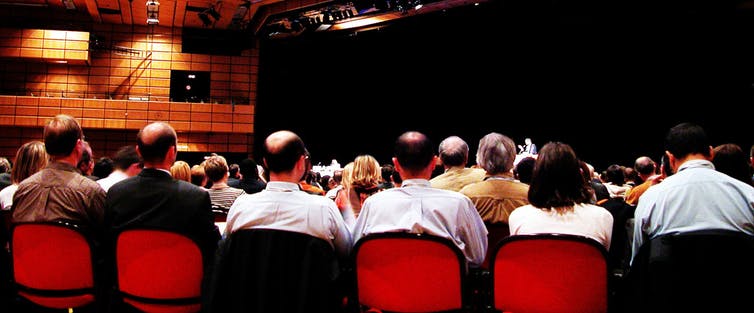
Women and
people of colour were also noticeably absent in some sessions. Shutterstock |
Race is
also a factor
also a factor
When
audiences are distracted, it signals that they do not value your work. Our
observations showed that while women presenters experienced more disturbances
than men, people of colour experienced the most significant disturbances during
their presentations.
audiences are distracted, it signals that they do not value your work. Our
observations showed that while women presenters experienced more disturbances
than men, people of colour experienced the most significant disturbances during
their presentations.
Our
research supports the argument that there are cultural norms in science that
cater to people in power and create entry barriers for those who, for example,
might be put off by aggressive questioning styles, aren’t part of inside jokes,
or don’t fit the stereotypical image of a scientist.
research supports the argument that there are cultural norms in science that
cater to people in power and create entry barriers for those who, for example,
might be put off by aggressive questioning styles, aren’t part of inside jokes,
or don’t fit the stereotypical image of a scientist.
If we
want to make geosciences more inclusive, we have to consider these behaviours
and norms. Many professional
societies are instituting codes of conduct, which provide attendees
with a way to report discrimination and hold perpetrators responsible, and may
promote shifts in culture and participation.
want to make geosciences more inclusive, we have to consider these behaviours
and norms. Many professional
societies are instituting codes of conduct, which provide attendees
with a way to report discrimination and hold perpetrators responsible, and may
promote shifts in culture and participation.
We saw,
for example, that having more women organizing sessions can help bring women
into conference spaces, while a recent
study found that women will ask more questions when another woman is called on
first.
for example, that having more women organizing sessions can help bring women
into conference spaces, while a recent
study found that women will ask more questions when another woman is called on
first.
White
academics should also make efforts to listen to people of colour, especially
women of colour, when they tell us about their experiences in STEM fields. In this
time of social change, the burden of proof can no longer be on marginalized
voices.
academics should also make efforts to listen to people of colour, especially
women of colour, when they tell us about their experiences in STEM fields. In this
time of social change, the burden of proof can no longer be on marginalized
voices.
Rather,
it now rests with the wider academic community, which must be frank about toxic
cultural norms that have been allowed to breed within research and educational
institutions.
it now rests with the wider academic community, which must be frank about toxic
cultural norms that have been allowed to breed within research and educational
institutions.
Let us
act now to create a disciplinary research force better suited to represent, and
work in service of, all humanity.
act now to create a disciplinary research force better suited to represent, and
work in service of, all humanity.
This is a
corrected version of a story originally published April 22, 2018. It clarifies
how conference registration data was used in the research.
corrected version of a story originally published April 22, 2018. It clarifies
how conference registration data was used in the research.

