Young Rural Women in India Chase Big-City Dreams
September 24, 2016

Experiments like one in Bangalore, luring migrants to fill factory jobs, collide with an old way of life that keeps women and girls in seclusion until an arranged marriage.
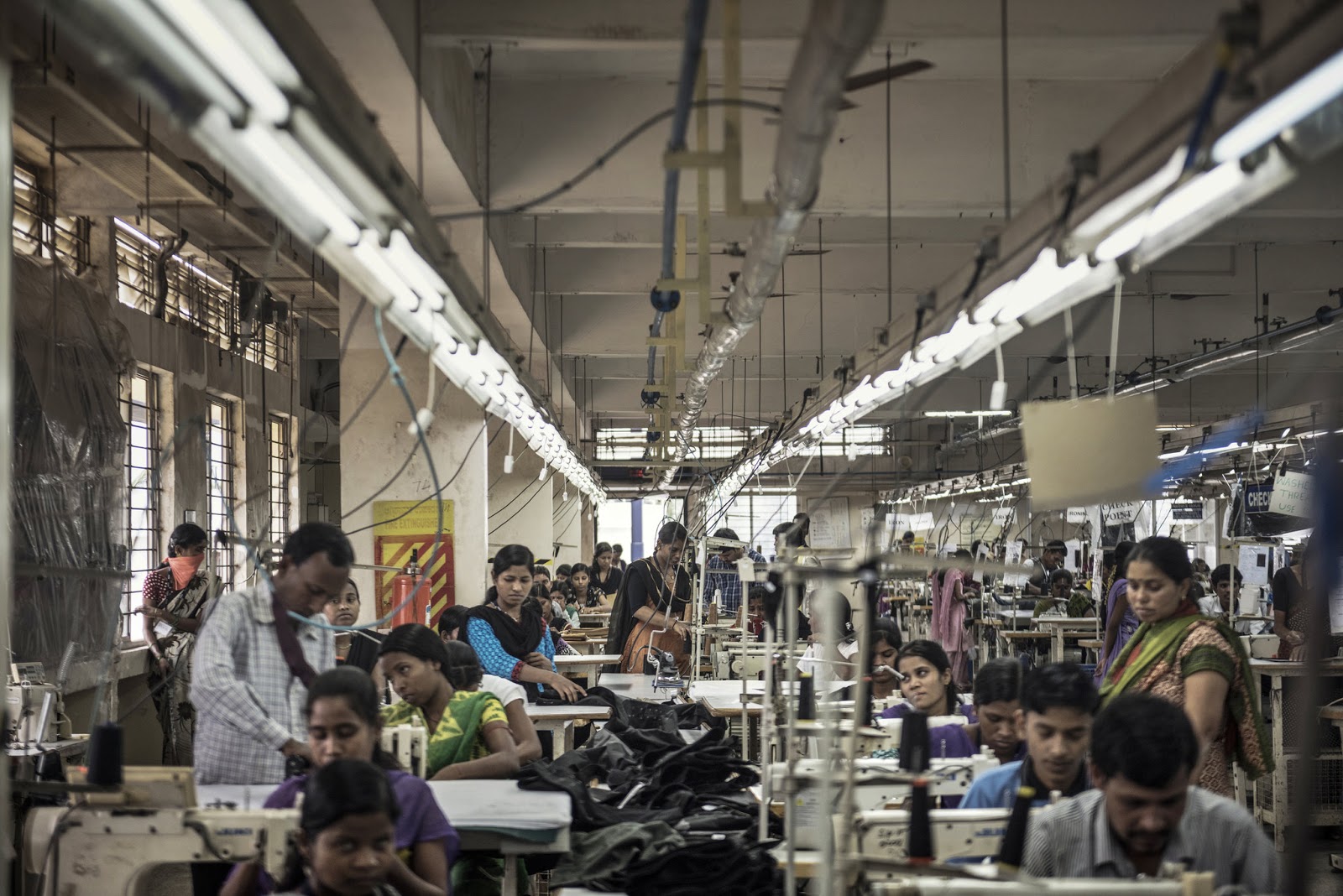
BANGALORE, India — The factory floor is going full throttle when the new girls walk in. Everywhere is the thrumming of sewing machines, the hum of fans, the faint burning smell of steam irons. On narrow tables that run between the machines, half-assembled Marks & Spencer miniskirts are thrust forward by fistfuls. The tailors, absorbed in the task of finishing 100 pieces per hour, for once turn their heads to look.
The new girls smell of the village. They have sprinklings of pimples. They woke well before dawn to prepare themselves for their first day of work, leaning over one another’s faces in silence to shape the edges of each eyebrow with a razor blade. Their braids bounce to their hips, tight and glossy, as if woven by a surgeon. On their ankles are silver chains hung with bells, so when they walk in a group, they jingle.
But it is impossible to hear this sound over the racket on the factory floor. The tailors glance up for only a moment, long enough to take in an experiment. The new workers — teenagers, most of them — have been recruited from remote villages to help factories like this one meet the global demand for cheap garments. But there is also social engineering going on.
A government program has drawn the trainees from the vast population of rural Indian women who spend their lives doing chores. In 2012, the last time the government surveyed its citizens about their occupation, an astonishing 205 million women between the ages of 15 and 60 responded “attending to domestic duties.”
Economists, with increasing urgency, say India will not fulfill its potential if it cannot put them to work in the economy. They say that if female employment were brought on par with male employment in India, the nation’s gross domestic product would expand by as much as 27 percent.
Experiments like the one in Bangalore run against deep currents in India, whose guiding voice, Mohandas K. Gandhi, envisioned a socialist future built on the small-scale economy of the village. They also collide spectacularly with an old way of life, in which girls are kept in seclusion until they can be transferred to another family through arranged marriage.
Bangalore is the first city the 37 trainee tailors have seen. They are dazzled by the different kinds of light. Picking their way through the alleys around the factory, a column of virgins from the countryside, they stare up at an apartment building that towers over the neighborhood and wish their mothers could see it.
Among them are two sisters, Prabhati and Shashi Das. They have come from a village at the end of a road, a place so conservative that the single time they went to a movie theater, their male cousins and uncles created a human chain around them, their big hands linked, to protect them from any contact with outside men. They are, as far as they know, the first unmarried women who have ever migrated from the village to work.
Neighbors in the village are waiting to see what happens. The nasty ones say, with obvious relish, it will end badly. They whisper about migrant workers whose eyes were removed by organ traders while they slept. They say Prabhati and Shashi will be “used this way and that.”
Still, they go. Prabhati, at 21, is stubborn and able, and Shashi, two years her junior, pretty and fizzing with suppressed laughter. The two sisters hook pinkies when they walk down the lane that leads to the factory.
“All the flirts and ruffians in the whole world must have been born on this lane,” Shashi grumbles, but she is laughing. Attention is like water to her.
The sisters are waiting, too, to see what will happen to them. They are both at the age when they could be summoned at any moment to be displayed to a family of strangers as a potential daughter-in-law. And each of them wants something else, something impossible.
It is late May, the first day of their factory summer — of love letters folded into squares and dropped onto work stations; of fevers sweated out on the floor of a bare hostel room; of supervisors shouting in a language they do not understand, a couple of words — “work” and “faster” — gradually becoming clear; of capitalism, of men and of a bit of freedom.
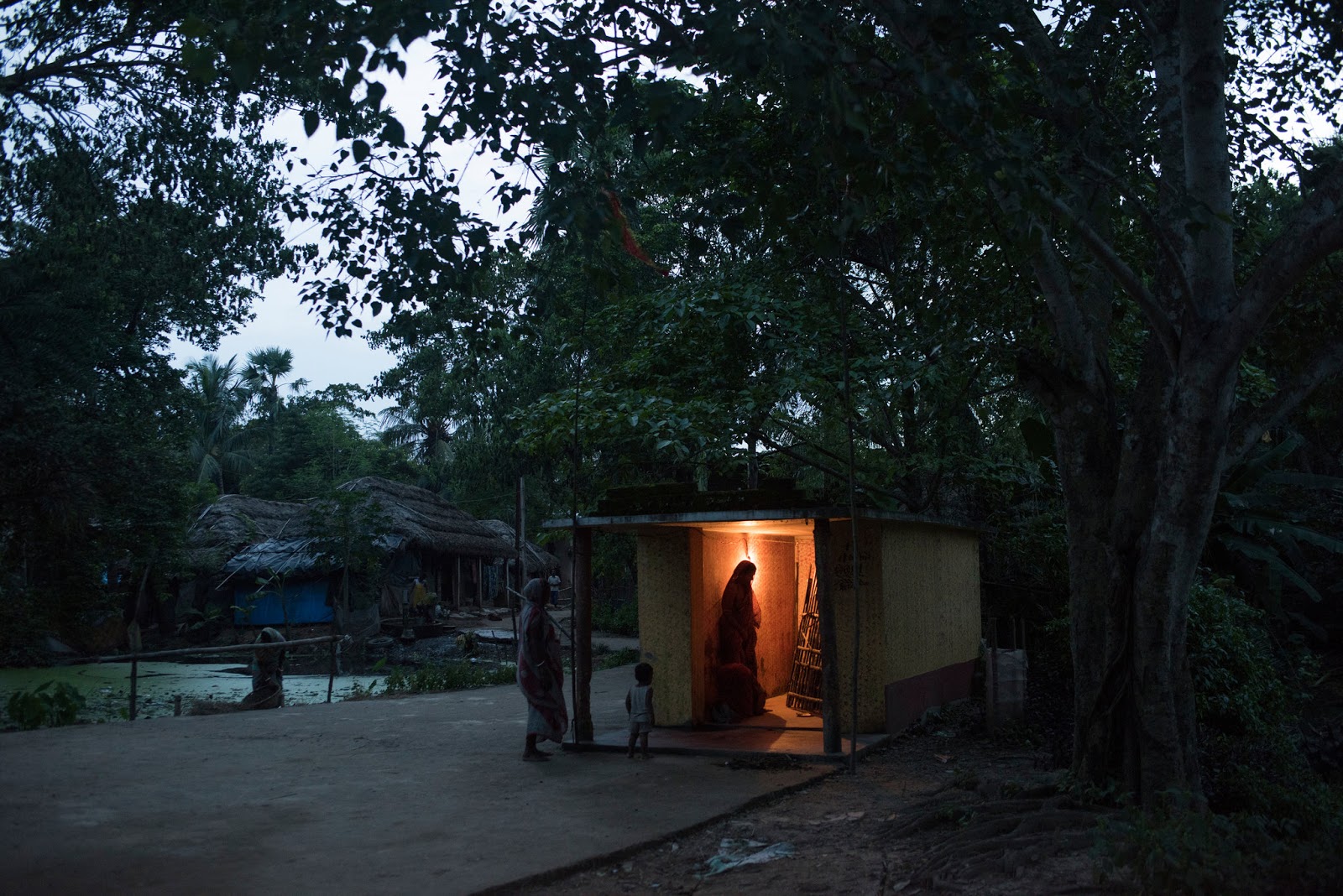
The village of Ishwarpur has a vast supply of idle young women.
Credit Andrea Bruce for The New York Times
Luring Idle Young Women
It all started in March, in the drippy jungle of rural Odisha, when two distant relatives happened to meet on the roadside.
One of the men had found employment as a “mobilizer” for Gram Tarang, a for-profit agency contracted by India’s government to recruit and train workers. He mentioned that Gram Tarang was offering a cash incentive — roughly 450 rupees, or about $6.75, a head — to mobilizers who identified young women willing to enroll in a training program for garment factory jobs.
The second man, Hemant Das, perked up, sensing the approach of a change of career. Hemant had an underfed look and teeth rimmed with tobacco stains. Among the first college graduates from his family, he had tried his hand at laying bricks, tutoring schoolchildren, programming computers, setting up wedding tents and waiting tables before finally falling back on the only job widely available to men here, working as a field hand for 200 rupees a day.
Hemant was from a village called Ishwarpur, and as it happened, idle young women were something Ishwarpur had in great quantity. That they could be monetized came as good news.
On its economic merits alone, Hemant figured, the government scheme would prove tempting: After two months of training, their daughters would be placed in a factory in the industrial center of Bangalore, where they would earn the legal minimum wage, 7,187 rupees per month, or about $108, which is more than most of their fathers make. Six months after arriving in Bangalore, they would be free to return home if they wished.
Hemant set out the next day with a fistful of pamphlets and an uncharacteristically sunny disposition. But as he made his rounds of local families — 30 of them, at least — they shook their heads. No. “Letting go of female children is dishonorable, in itself,” explained Pramanand Das, who presides over an informal family council.
Minati Das, the mother of a 19-year-old, got to the point quicker. “Not everyone wants a daughter-in-law who is a working woman,” she said. “They think she has lost her chastity.”
The village had its own plan for these young women. Upon reaching adulthood, they would be transferred to the guardianship of another family, along with a huge dowry that serves as an incentive to treat them well. The transfer is final. Once married, the new bride cannot return to visit her parents without permission, which is given sparingly, so that the bonds to her old home will weaken.
She must show her submission to the new family: She is not allowed to speak the names of her in-laws, because it is seen as too familiar, and in some places she is not allowed to use words that begin with the same letters as her in-laws’ names, requiring the invention of a large parallel vocabulary. Each morning, before she is allowed to eat, the daughter-in-law must wash the feet of her husband’s parents and then drink the water she has used to wash them.
Hemant would have been completely out of luck if he had not thought to try Karuna Das, who had two daughters of marriageable age. Karuna was a sinewy day laborer, and he had roamed far from the village in his younger days to work in iron foundries in Chennai and Hyderabad. The gossip was that Karuna agreed to enroll his eldest daughters because he was unable to scrape together 100,000 rupees for dowries. That was undoubtedly the case.
It was also true that Karuna did not care much what other people said. He had never behaved like a poor man. When word spread that he had agreed to send Prabhati and Shashi, the village elders convened emergency meetings to determine whether this violated “purdah,” or separation between the sexes, and whether this would damage the marriage prospects of their own daughters. Women stopped by to tease the girl’s mother, Radha Rani, who wept inconsolably.
It turned out that Karuna had not been asking for permission. He instructed his daughters to pack four or five changes of clothes. Go see what the world is like, he told them. “They were reluctant to go anywhere because they were a bit scared,” he said. “I told them being scared is O.K. O.K., you’re scared. Now you have to move on.”
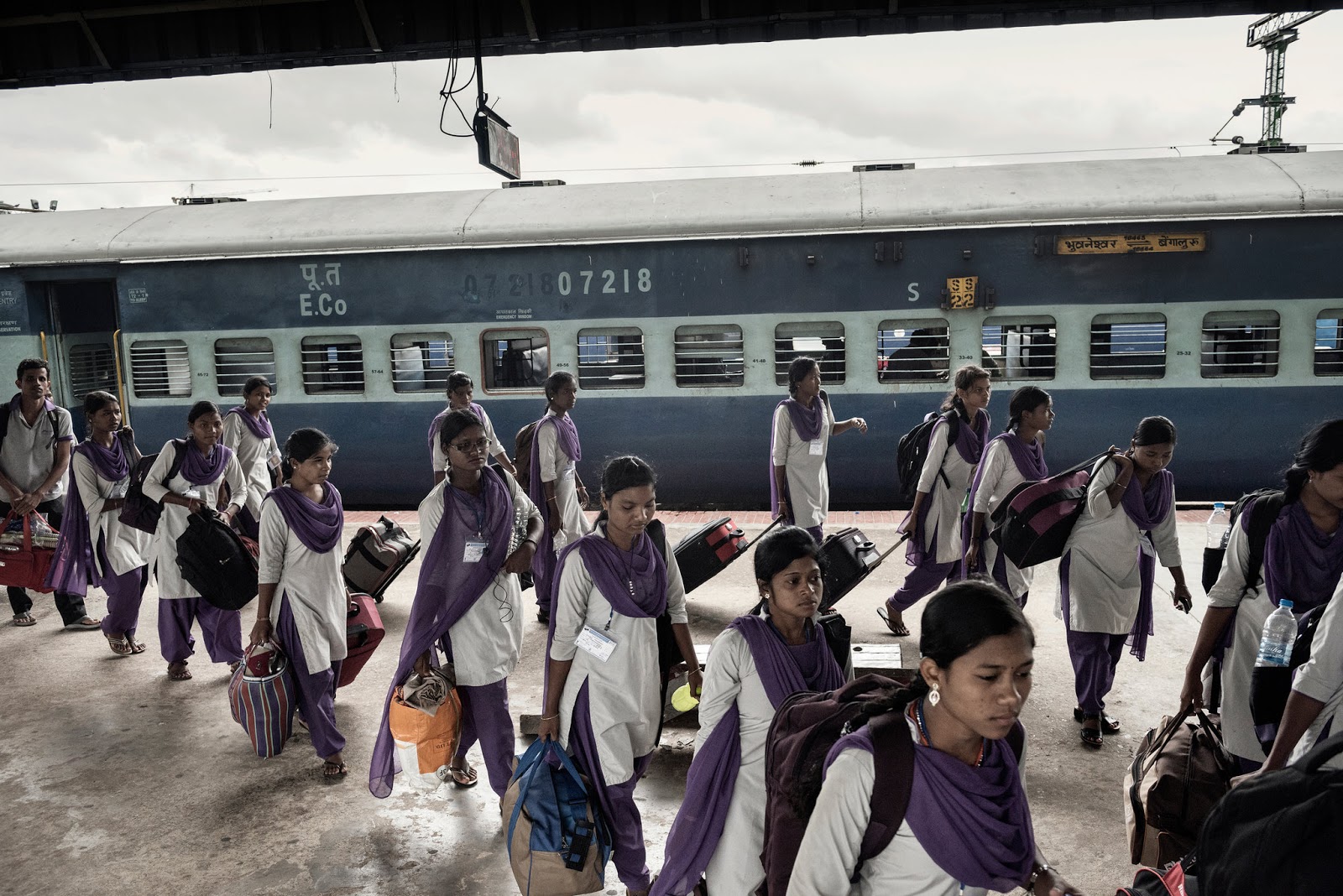
Girls arriving in Bangalore in June from rural villages for their new factory jobs.
Credit Andrea Bruce for The New York Times
First Train Ride
Prabhati has never seen a train, much less ridden in one, and on the 33-hour journey to Bangalore the earth seems to heave under her. As miles of paddy fields slide by, she vomits. Thatch roofs are replaced by peaked roofs, and she vomits. When they reach south India, rain begins to hit the window in fat spatters.
It had come as news to Prabhati that the training program involved traveling 900 miles. But some intention had hardened within her. She wanted to prove the neighbors wrong. She did not care about her marriage prospects because, after examining the marriages that surrounded her in Ishwarpur, she decided she did not want to marry at all.
“I will go to Bangalore,” she told her parents. “If I come back, then you can get me married. If I don’t come back, you can’t get me married.”
Shashi sits beside her retching sister and strokes her back. She had not wanted to come. Happy enough with a future as a housewife, she had focused her energy on making mischief. Among friends, she introduced herself as “45 kilograms of hotness.” Out of the corner of her mouth came a stream of dirty jokes, and she made the other girls dissolve in helpless laughter by comparing breast sizes to vegetables (including, mournfully, a kernel of corn).
Working on an assembly line was not Shashi’s idea of fun. But Prabhati plunged forward, and, as usual, Shashi cruised along in her wake.
The sisters, lugging a bag of clothes, sit with 35 other girls from Odisha who are making the same journey.
They have all dressed in baggy purple-and-gray uniforms, with ID cards swinging from their necks. Their parents had made last-minute attempts to keep them from leaving, which had to be repelled with sustained tantrums. A girl called Baby, who is 18 and bespectacled, said that she had secured her mother’s permission only by refusing to eat for two days.
“They wanted me to come home,” she says. “I’m not going home.”
The Gram Tarang instructors had taught them an anthem about self-sufficiency, and they sing it on their journey to Bangalore, again and again, for comfort.
We will stay a month and train ourselves
This job is the story of our lives
The job is as important as prayer
We won’t fear, and we will go ahead.
The sun has not yet risen when they arrive at the hostel that will be their new home for the next six months: 137 women in 15 unfurnished rooms, every inch covered with girlish flotsam, underwear and bras drying on the window grates, sentimental verses penciled on the walls.
Prabhati and Shashi’s room is being painted, so on the first night 25 of them crowd into two rooms, so tight that one of their roommates stretches out on the kitchen counter. “I thought there would be beds,” murmurs one, and the chaperone from Gram Tarang looks exasperated.
“They complain, ‘You could have given us this, you could have given us that,’” he says. “We sweetly explain that it is not possible. They don’t have the bed system in Bangalore.”
But the girls are too keyed up to sleep. Climbing onto the roof, they can see the sun rising over a landscape of other roofs, where, in all directions, migrants seek a breath of quiet. There they can gaze up at the 22nd story of an apartment building, where residents come out to hang their laundry on balconies. It is the most amazing thing they have ever seen: big people looking tiny.
“I want to see what I haven’t seen,” murmurs one of the girls, sleepily. “I want to see what I don’t even know exists.”
Baby says something about her eventual return to India, and when someone corrects her, she looks up sharply.
“Bangalore is in India?” she asks.

Girls living in a Bangalore hostel watched the street life below.
Credit Andrea Bruce for The New York Times
Unlearning Village Lessons
For the first few weeks, everything is new. Stepping out of the hostel, the trainees are surrounded by men: Men on balconies, men on scooters, men lounging in doorways, staring. The road is plastered with signs saying “tailors wanted,” and one girl gives a yelp of alarm, mistaking them for wanted posters.
On the day of a Hindu festival, Prabhati peers down from the roof at a troupe of transgender dancers, smiling and twitching suggestively as men press in around them. When one bends down so that an onlooker can stick a folded bill in her cleavage, Prabhati is so shocked that she has an impulse to reach for a stone and throw it.
“If this happened in the village,” she says, “you would all be dead.”
In rural Odisha they like to say that “a girl’s shyness is her jewelry.” But here, there is no space for the newcomers unless they make space for themselves. To cross the street — a throbbing two-lane road coursing with auto rickshaws, clattering cargo trucks, scooters carrying whole families — requires stepping in front of the slower-moving vehicles, if necessary stopping them with their bodies. The girls waver, and then they plunge.
Much of what they learned in the village must be unlearned here. One evening when Baby begins preparing dinner, several of her roommates protest. She is menstruating, and caste tradition dictates that menstruating women must live in isolation, sleeping alone and taking care not to step into the kitchen, lest they contaminate the food and water. So two of the younger roommates cook, emerging an hour later with a glutinous, inedible glop. At this point, Baby is irritated. Menstruating women are allowed to work in the factory, aren’t they? She walks into the kitchen, and the scent of spices and onions fills the room. After a brief discussion, they agree that the menstruation rules will be void for as long as they are living in Bangalore. Then they stuff themselves with food and fall into a deep sleep.
When they are introduced to a factory supervisor and dive to touch her feet, a traditional gesture of respect toward elders, the supervisor jumps back as if she has been stuck with a hot poker. She then assumes a slight crouch, as if preparing to defend herself from further reverence.
Back in their bedrooms, the girls laugh hysterically at this. From childhood, they have been told that it is disrespectful for a girl to laugh out loud in the presence of elders. In the event of irrepressible laughter, girls must cover their mouths with anything at hand: the corner of a dupatta, a hand, a washcloth. This lesson, too, flies out the window. In the hostel they laugh like tractors. They laugh so loud they spit their water out.